Critical Review: A Masterclass in Victorian Psychological Thriller Writing
Verdict: ★★★★★ Moriarty: The Napoleon of Crime transcends the typical Sherlock Holmes pastiche to deliver a haunting psychological portrait that will satisfy both devoted Sherlockians and newcomers to Victorian crime fiction. This is literary historical fiction at its finest—intelligent, meticulously researched, and devastatingly original.
A Revolutionary Take on the Holmes Canon
Aleksandr Mazo achieves what few Holmes adaptations dare attempt: complete fidelity to Arthur Conan Doyle's original stories while crafting an entirely new narrative perspective. The novel treats canonical events—from "The Valley of Fear" to "The Final Problem" and "The Adventure of the Empty House"—as historical fact, weaving Professor James Moriarty's untold origin story through the spaces between established Holmes adventures. The result is a Victorian crime novel that enriches rather than contradicts Doyle's masterwork, offering longtime Holmes enthusiasts fresh insights while remaining accessible to readers discovering Baker Street for the first time.
Psychological Depth Beyond Traditional Crime Fiction
This is not merely a criminal's memoir but a sophisticated exploration of power, manipulation, and intellectual warfare in late-Victorian England. Mazo's Moriarty emerges not as a cartoon villain but as a fully realised character whose mathematical precision extends from equations to human psychology. The narrative traces his evolution from a bullied scholarship student at Durham's St Ignatius's Academy to the criminal mastermind Holmes would call "the Napoleon of Crime." Each calculated step in this transformation feels inevitable yet shocking, grounded in historical detail and psychological realism that elevates the novel above typical period crime fiction.
Martial Arts and Victorian Combat Authenticity
One of the novel's most innovative elements is its treatment of Bartitsu—the real Victorian martial art that Doyle briefly mentioned saved Holmes at Reichenbach Falls. Mazo expands this detail into a central theme, introducing Japanese jujutsu training sequences that are both historically accurate and philosophically rich. The combat scenes emphasise technique over spectacle: breathing patterns, weight distribution, joint locks, and the concept of "yielding" as strategic advantage. These meticulously researched martial arts elements inform not just the action sequences but Moriarty's entire worldview, where physical and intellectual leverage become indistinguishable.
Narrative Structure: A Chess Match in Prose
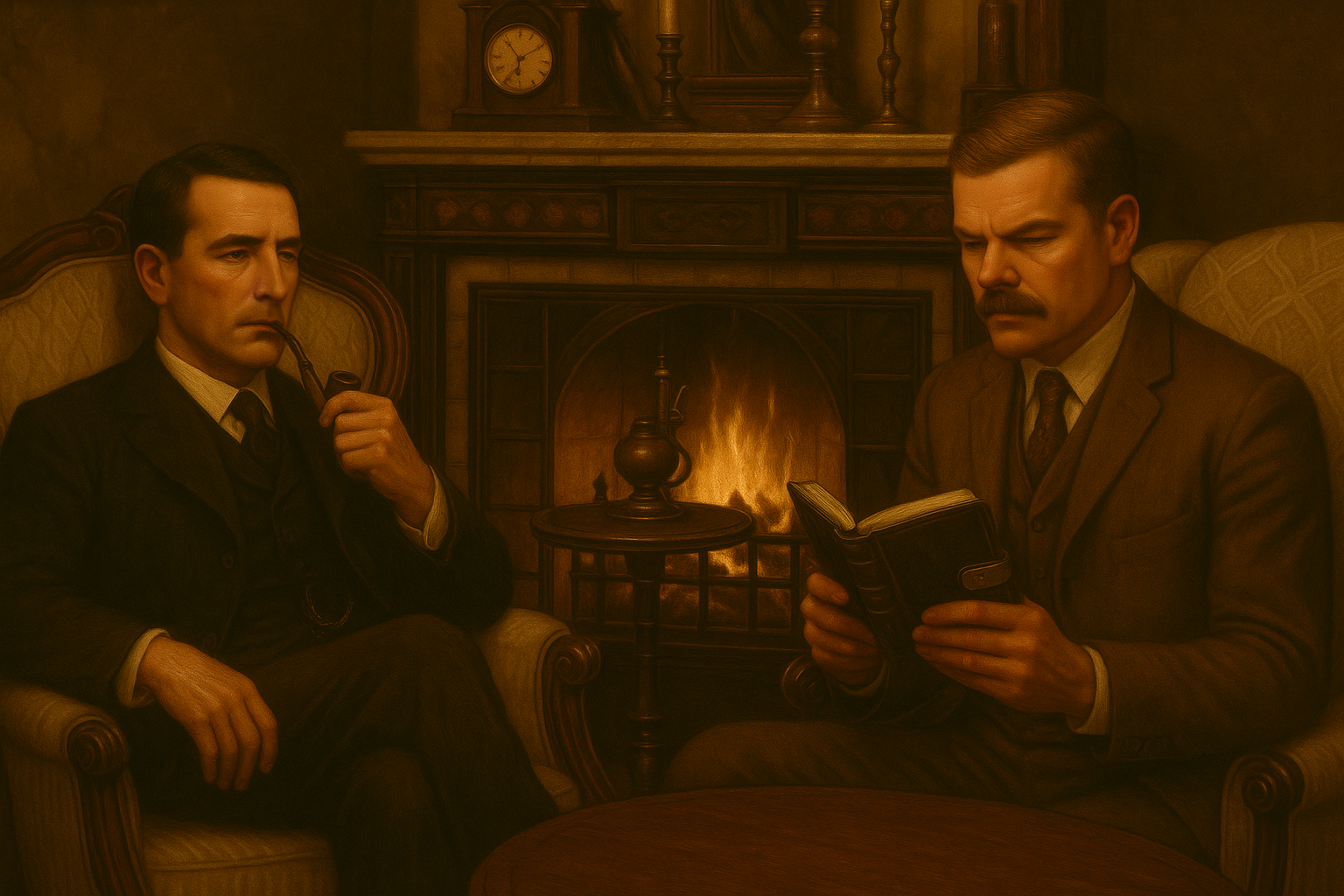
The novel's architecture mirrors its protagonist's mathematical mind. Beginning with a frame narrative featuring Holmes and Watson discovering Moriarty's journal in 1894, the story unfolds with the precision of a geometric proof. Early chapters establish the childhood trauma and systematic bullying that forge young James Moriarty's philosophy. The middle sections detail his education in combat and manipulation, including his complex relationship with a Japanese martial arts master and the tragic loss that catalyses his transformation. The final act orchestrates his rise through London's criminal underworld, culminating in the legendary confrontation at Reichenbach Falls. Each chapter builds upon the previous with mathematical inevitability, creating mounting tension that makes this Victorian thriller impossible to put down.
Victorian London Brought to Vivid Life
Mazo's Victorian England breathes with authentic period detail without drowning in exposition. From the gaslit alleys of Durham to the exclusive clubs of St James's, from the Metropolitan Bank's Chubb six-lever vault mechanisms to the specific train schedules of the Continental Express, every detail serves the story while immersing readers in 1880s Britain. The author captures the era's class tensions, casual xenophobia, and the shadows cast by Empire with unflinching accuracy. References to historical figures and events—from bare-knuckle prizefighters to the Bangalore Pioneers—ground the fiction in researched fact.
Literary Prose That Demands Attention
The prose style perfectly captures late-Victorian formality while remaining compulsively readable for modern audiences. Moriarty's narrative voice—cold, precise, yet occasionally revealing unexpected depths—creates an unsettling intimacy. Aphorisms like "strength is loud, precision quiet" and "narrative outlives bodies" feel earned rather than affected. The author employs British spelling and grammar throughout, lending additional authenticity. Particularly noteworthy are the chess metaphors woven throughout, transforming criminal schemes into elegant endgames.
Character Development: Villains as Complex Humans
While James Moriarty commands centre stage, the supporting cast proves equally compelling. Colonel Sebastian Moran appears not as a simple henchman but as a complex figure—an Empire's discarded war hero seeking purpose in London's underworld. The mysterious Shaw character adds layers of tragedy and deception. Young Jamie Moriarty provides a haunting parallel narrative of guilt and obligation. Even minor characters like the bitter cook Walter Griggs and reluctant forger Edwin Trent feel three-dimensional, with clear motivations driving their descent into criminality.
Themes That Resonate Beyond Genre
Beneath its Victorian crime thriller surface, the novel explores timeless themes: the transformation of victimhood into power, the weaponisation of narrative, the price of genius without empathy. Moriarty's journey from abused student to criminal mastermind asks uncomfortable questions about justice, revenge, and whether brilliance divorced from morality becomes mere monstrosity. The recurring motif of "leverage"—physical, psychological, social—creates thematic coherence while commenting on power structures that transcend the Victorian era.
The Perfect Balance of Action and Intellect
Action sequences—from back-alley jujutsu demonstrations to the Metropolitan Bank heist to the climactic struggle at Reichenbach—are choreographed with cinematic clarity while maintaining period authenticity. Yet the novel's greatest tensions arise from intellectual confrontations: forged letters that destroy reputations, mathematical proofs that reveal criminal intent, and the chess-like mental duel between Holmes and Moriarty that spans continents. This balance ensures the novel appeals equally to readers seeking Victorian adventure and those craving psychological complexity.
Historical Mystery Meets Literary Fiction
What elevates Moriarty above typical historical crime fiction is its literary ambition. The novel functions simultaneously as period thriller, character study, and meditation on narrative itself. The frame device—Holmes analysing Moriarty's journal creates meta-textual layers that reward careful readers.
Comprehensive Strengths
• Canonical Integrity: Seamlessly integrates with Doyle's original Holmes stories without contradiction
• Historical Accuracy: Meticulously researched Victorian England details from architecture to combat techniques
• Character Complexity: Multi-dimensional portrayal of literature's greatest criminal mastermind
• Martial Arts Innovation: Authentic representation of Victorian-era jujutsu and Bartitsu
• Narrative Sophistication: Frame story and unreliable narrator add interpretive depth
• Prose Excellence: Period-appropriate language that remains accessible to modern readers
• Thematic Richness: Explores power, manipulation, and moral corruption with philosophical weight
• Pacing Mastery: Maintains tension across 26 chapters without sacrificing character development
• Genre Transcendence: Succeeds as crime fiction, historical novel, and literary character study
• Series Potential: Complete story while establishing foundation for Victorian Moriarty Saga
Perfect For Readers Who Enjoyed
Sherlock Holmes devotees seeking canon-compliant expansion of Doyle's universe; fans of Anthony Horowitz's Moriarty and The House of Silk; readers of Caleb Carr's The Alienist series; admirers of Michael Dibdin's The Last Sherlock Holmes Story; those who appreciated Dan Simmons' The Fifth Heart or Lyndsay Faye's Dust and Shadow; Victorian mystery enthusiasts who loved Michel Faber's The Crimson Petal and the White; and anyone drawn to intelligent historical fiction that respects its source material while daring creative innovation.
Critical Assessment
Aleksandr Mazo has crafted something remarkable: a Moriarty origin story that feels both inevitable and surprising. The novel succeeds on multiple levels—as gripping Victorian thriller, as psychological character study, and as meta-commentary on the nature of narrative itself. While purist readers might initially balk at humanising Holmes's greatest adversary, Mazo never asks for sympathy—only understanding. The result is a novel that enriches the Holmes canon while standing independently as superior historical crime fiction. This is essential reading for Sherlockians, highly recommended for historical mystery enthusiasts, and a must-read for anyone who appreciates literary fiction that refuses genre limitations.
Reviewed by Victorian Crime Fiction Quarterly. This spoiler-free review examines Book One of the Victorian Moriarty Saga without revealing major plot developments. The novel stands complete while establishing foundations for the continuing series.